Introduction: The Rise of SaaS and Its Global Impact
Software as a Service (SaaS) has completely transformed how organizations acquire, use, and maintain software—not just globally, but increasingly here in Bangladesh.
Instead of installing software on individual computers or managing expensive on-premise servers, SaaS allows businesses to:
- Access powerful tools via the internet
- Pay on a subscription model (no significant upfront fees)
- Get regular features, updates, and security patches — handled by the vendor.
From email suites to CRM systems and enterprise resource planning (ERP) systems, SaaS has become the standard across various industries.
Global SaaS Adoption: Why It Works
SaaS has seen explosive growth because it offers:
- Lower capital expenditure (CapEx)
- Access anytime, anywhere — ideal for remote teams
- No maintenance hassles — providers handle it all
- Instant scalability as needs grow or shrink
Whether it’s a two-person startup using Google Workspace or a multinational using Salesforce, the Software as a Service model fits all business sizes.
The SaaS Wave Reaches Bangladesh
In Bangladesh, the shift toward cloud-based tools is rapidly gaining traction.
Historically, many local organizations stuck with:
- Offline tools
- On-premise systems
- Even manual processes — due to fears about connectivity and data security
Now, that’s changing fast.
Key Forces Accelerating SaaS Adoption in Bangladesh:
- Improved internet infrastructure (4G rollouts, fiber broadband, mobile networks)
- A growing, tech-aware workforce ready to embrace new tools
- National digital transformation missions like:
- Digital Bangladesh
- Smart Bangladesh Vision 2041
- The COVID-19 pandemic showed the value of being cloud-ready:
- Businesses with cloud-based collaboration tools (email, storage, video calls) transitioned to remote work far more easily
A shift that would have taken a decade is now happening within just a few years.
What This Blog Will Cover
In this blog post, we’ll dive into:
- Why SaaS adoption is accelerating in Bangladesh
- Key benefits SaaS offers to local businesses
- Challenges and limitations worth considering
- How KuiperZ helps businesses implement SaaS effectively
- Forward-looking trends in SaaS adoption and what’s next for Bangladesh
Why SaaS Adoption is Increasing in Bangladesh
Just a few years ago, many Bangladeshi businesses were skeptical about cloud-based solutions. Today, the landscape is rapidly evolving — and SaaS is going mainstream.
Here are some key drivers behind this growing adoption in Bangladesh:
Improved Internet Access
One of the biggest enablers of Software as a Service growth is better connectivity.
Bangladesh has made impressive strides in nationwide internet access:
- Expansion of 4G mobile coverage
- Rollout of fiber-optic broadband in major cities
- Government initiatives to promote rural digital connectivity
As of 2024, Bangladesh has around 77 million internet users. (Source: datareportal.com)
This makes SaaS platforms — which rely on always-on internet — far more viable, even outside metropolitan areas.
As barriers to online access disappear, cloud-based tools are becoming a logical step forward.
Cost and Resource Efficiency
For SMEs in Bangladesh, SaaS offers significant budgetary advantages:
- No need to purchase expensive on-premise servers
- No IT team required to handle installations & updates
- Monthly or yearly subscription models shift IT from CapEx to OpEx
This is particularly attractive in a price-sensitive market where most businesses want to avoid significant upfront investments.
But even larger companies are rethinking their costs:
Why manage your email server, backup systems, or antivirus tools — when Software as a Service providers offer more secure, scalable, and cost-effective solutions?
Globalization and Remote Work
Bangladeshi businesses are becoming more globally connected than ever.
- Many local IT firms, agencies, and startups work with international clients
- Teams often include remote or freelance members
- Bangladesh is a growing hub for freelance tech talent
Remote collaboration tools like:
- Slack / Microsoft Teams
- Google Workspace / Dropbox
- Notion / Trello / Asana
…have become must-haves for operations involving distributed workforces.
The COVID-19 pandemic was a wake-up call:
Firms with SaaS tools (cloud email, storage, CRM) transitioned to remote work relatively painlessly, while others struggled to digitize their operations overnight.
Local Success Stories and Growing Awareness
Success breeds more success.
Numerous startups, e-commerce shops, and service firms in Dhaka have scaled their operations using SaaS for:
- Website hosting and store management
- Team collaboration
- HR and payroll
- CRM and marketing automation
These case studies are being shared through tech events, forums, and startup incubators, increasing awareness across the business community.
Business leaders are now actively asking:
“Should we be using a Software as a Service ERP/CRM?” instead of “What is SaaS?”
This local momentum is fueling peer influence and significantly accelerating adoption.
Supportive Government Initiatives
National digital transformation goals are also playing a significant role.
Bangladesh’s journey from Digital Bangladesh to Smart Bangladesh Vision 2041 includes:
- Increased investment in digital infrastructure
- Wider adoption of e-government platforms
- Focus on cloud-based service delivery
Example:
The government has even launched a sovereign cloud infrastructure for securely storing public data.
(Source: oracle.com)
This sends a strong message: If critical public services can run securely on the cloud, so can businesses in the private sector.
The Bottom Line?
SaaS in Bangladesh is no longer just following a trend — it’s becoming a business necessity.
From startups to established firms, across various sectors, businesses are realizing the benefits of cost-effective, scalable, cloud-based tools.
The cloud isn’t coming — it’s already here.
And at KuiperZ, we’re helping Bangladeshi businesses seize this opportunity.
Key Benefits of SaaS for Businesses

Adopting Software as a Service (SaaS) offers significant advantages for businesses of all sizes — particularly those in Bangladesh’s evolving tech landscape.
Here are some of the top benefits:
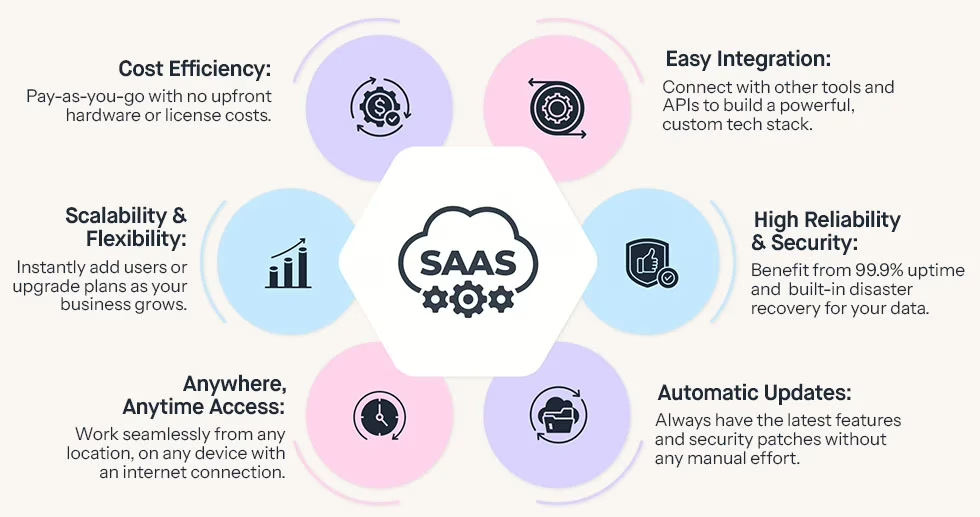
Cost Efficiency
Traditional software comes with significant upfront costs:
- Expensive licenses
- Hardware to run servers
- Ongoing maintenance and IT staffing
With SaaS:
- You pay-as-you-go (monthly, yearly, or per user)
- No servers or installations needed — it’s all hosted in the cloud
- Updates and support are typically included in the subscription
Example: Instead of paying ৳200,000 upfront for accounting software and a server, an SME can subscribe to an online accounting tool for a few thousand taka per month.
Result: Reduced barriers to entry and predictable IT spending.
Scalability and Flexibility
Business needs change — and fast.
With SaaS, it’s easy to:
- Add users or storage instantly
- Upgrade or downgrade service plans as needed
- Pay only for what you use, when you use it
Businesses with seasonal fluctuations or growth spurts can scale on demand — no downtime, no over-investment in IT.
Ideal for startups, growing SMEs, or teams with unpredictable workloads.
Accessibility Anywhere, Anytime
One of SaaS’s biggest advantages: access from anywhere with an internet connection.
- Teams in multiple cities (e.g., Dhaka, Chattogram) can sync in real time
- Remote employees and traveling staff can work effectively
- Work-from-home transitions (like during COVID-19) are smooth and seamless
📲 Check your CRM on your phone from a client site? ✔️
💼 Send invoices from a café? ✔️
Software as a Service means business on-the-go — reducing delays and decentralizing power.
Automatic Updates and Innovation
With SaaS, you’re always on the latest and best version.
No lengthy upgrade processes. Zero downtime. No extra fees.
Providers:
- Push new features automatically
- Apply security patches in the background
- Introduce improvements without asking you to install anything
Example: A cloud-based ERP adds new analytics dashboards → clients use it immediately, no complicated deployment needed.
You ride the wave of innovation, without ever falling behind.
Reliability and Disaster Recovery
SaaS platforms often boast:
- 99.9% uptime
- Infrastructure hosted on enterprise-grade cloud systems
- Regular automated backups
- Built-in disaster recovery plans
This is especially important in Bangladesh, where:
- Power or infrastructure instability can affect on-premise setups
- Hiring full-time IT teams can be costly for SMEs
- Data loss from hardware failure is not uncommon
With SaaS, your data lives securely in the cloud, not on one fragile device.
(Bonus) Integration Flexibility
Most Software as a Service platforms support API connections or third-party plugin support.
This allows businesses to:
- Build a custom tech stack suited to their needs (e.g., CRM + Accounting + Support)
- Share data across platforms easily
- Automate repetitive workflows between tools
🔧 While we won’t go deep here, integration is another huge advantage that lets SaaS tools work better together.
Challenges and Concerns with SaaS Adoption

While the benefits of SaaS are undeniable, the transition to cloud-based software isn’t without its hurdles.
Here are some of the key concerns Bangladeshi businesses often consider — along with practical ways to address them:
| Concern | Details | Solutions |
|---|---|---|
Data Security and Privacy |
“Is my data safe in the cloud?” This is the top concern for companies considering SaaS solutions. With SaaS, your business data — including customer information, financials, or operational details — is stored on external cloud servers, not on your local premises. This raises valid concerns around:- Data breaches- Unauthorized access- Compliance with industry regulations | What to do:- Choose SaaS providers with security certifications like ISO 27001 or SOC 2- Ensure end-to-end encryption is in place (at rest and in transit)- Confirm GDPR-style compliance standards- For regulated industries (like banking or healthcare), confirm support for data residency laws |
Internet Dependency | SaaS = cloud-based. No internet = no access. Simple. While internet infrastructure in Bangladesh has improved significantly (especially in cities), outages or slowdowns can still be disruptive — especially in rural areas or during peak hours. 🚧 Until 5G or full fiber-optic coverage becomes standard nationwide, this concern remains essential for business continuity. | Mitigation strategies:- Have a secondary ISP or mobile broadband as backup- Use SaaS tools that offer limited offline access or data export- Consider a hybrid model for business-critical processes |
Cultural Change and Trust | From “we own the server” to “we access it online” — it’s not just a tech shift, it’s a mindset shift. Many companies (especially long-established ones) have:- Comfort in visible, in-house systems- Skepticism around external control- Preference for manual processes ("We've done fine on paper") 🧩 Trust builds with familiarity — the proper proof points can spark internal buy-in. | Solution:- Educate decision-makers and staff on benefits & use cases- Run non-critical pilot projects using SaaS (e.g., HR or team chat)- Share real-world case studies, particularly from local industries |
Local Payment & Support Challenges | Most international SaaS platforms:- Charge in USD or EUR- Accept credit cards only- Have customer support teams located overseasThis can pose obstacles for Bangladeshi businesses in terms of:- Foreign transaction fees- Currency fluctuations- Unavailable support during local business hours 💡 KuiperZ works closely with both local and global SaaS partners to streamline this whole process. | What to look for:- SaaS products with Bangladeshi resellers, regional billing, or mobile payment options- Vendors with local consultants or certified partners- SaaS tools that offer chat/email support in your time zone |
Data Residency and Compliance | Data residency is becoming a compliance issue in many sectors. Some laws require data to be stored in the country of operation. While many SaaS providers host data in nearby regions (e.g., Singapore, India), this may not meet legal requirements for all businesses. 📢 Notable local development:The Bangladesh government has established a sovereign cloud infrastructure (Oracle-backed) to host public data securely Source: oracle.com | Current solutions:- Choose SaaS options with regional or country-specific hosting plans- Explore hybrid approaches (SaaS + secure private storage)- Clarify data residency terms in vendor agreements |
Over time, expect more local cloud infrastructure options to emerge, which will significantly ease this transition.
Final Thoughts on SaaS Concerns
SaaS adoption in Bangladesh is skyrocketing, but it’s completely normal — and intelligent — for businesses to proceed with thoughtful questions.
The goal isn’t to rush, but to:
- Be informed
- Work with reliable vendors
- Move forward with the support of a trusted implementation partner
That’s precisely what KuiperZ is here to help with.
How KuiperZ Supports Businesses with SaaS Solutions

Transitioning to cloud-based tools can be daunting — especially without experienced guidance.
That’s where KuiperZ steps in.
We help businesses in Bangladesh successfully adopt, implement, and optimize SaaS solutions from strategy to support.
Here’s how:
1. Cloud Strategy & Consultation
Not sure where to start with SaaS?
We offer consultation services to evaluate your current tech stack — and identify:
- What tools can move to SaaS
- Where cloud adoption will offer value
- Which options match your budget, growth plans, and compliance needs
Whether you need a 100% cloud environment, or a hybrid model (part on-premise, part SaaS) — we help you choose the best-fit approach.
Example: A financial firm might move CRM and HR to SaaS, but keep secure transaction servers in-house — we help design that balance.
2. SaaS Implementation & Integration
Once a SaaS solution is selected, we handle the entire implementation process:
- Setting up and configuring the software
- Customizing fields and workflows
- Migrating relevant data
- Ensuring internal process continuity
We also ensure seamless integration with your existing tools or legacy systems via APIs, data pipelines, or automation workflows.
Use Case: You adopt a new SaaS ERP but still use an in-house inventory system — KuiperZ builds the link so data flows smoothly.
No downtime. No data loss. Just smooth adoption.
3. Custom SaaS Development (If Needed)
Can’t find a SaaS product that fits your needs?
Or want to build a proprietary service-only platform?
KuiperZ specializes in custom cloud-based app development.
Let us help you:
- Build custom SaaS tools from scratch
- Adapt open-source software into SaaS models
- Host cloud-based tools with web/mobile access for staff and clients
Example: A logistics firm wants a shipment tracking dashboard that clients can access on demand. We build and securely host it — as a SaaS product, only they can use it.
Custom functionality. Web-based access. Cloud scalability.
4. Training & Ongoing Support
Bringing in a new tool is only half the battle — making sure your team can use it confidently is where success lies.
KuiperZ provides:
- Step-by-step onboarding and training
- Internal workflow guidance
- Support for non-tech-savvy team members
- Local language assistance if needed
- Post-launch support and health checks
If questions pop up, features need tweaking, or new team members join — we’re just a call or WhatsApp away.
We don’t walk away after the launch — we stick with you to ensure long-term value.
The KuiperZ Edge: Your SaaS Success Partner
When you work with KuiperZ, you don’t just get IT support —
You get a local, strategic partner dedicated to your digital transformation journey.
We help you:
- Leverage cloud with confidence
- Reduce IT costs
- Increase team efficiency
- Improve customer experience
- Stay secure and compliant
Our local market understanding + international SaaS experience = A solution tailor-made for businesses in Bangladesh.
Let us take care of your entire SaaS journey — from software advice to training across your whole team.
Future Trends in SaaS for Bangladesh

As SaaS in Bangladesh moves beyond early adoption, the future holds exciting possibilities for digitally empowered businesses, local innovation, and industry-specific transformation.
Here are some key trends to watch:
1. Rise of Local SaaS Providers
Expect to see more Bangladeshi tech companies building SaaS products that cater to local market needs.
Why this is important:
- Local SaaS providers understand cultural nuances, regulatory requirements, and unique industry practices
- They can enable:
- BDT pricing
- Integration with local payment gateways like bKash/Nagad
- Native Bangla interfaces
Just as India has produced SaaS leaders like Zoho and Freshworks, Bangladesh is ripe for innovation in:
- Microfinance & mobile banking
- RMG supply chain & manufacturing
- EduTech in Bangla
This shift will make SaaS more accessible and practical for homegrown businesses.
2. Industry-Specific Cloud Solutions
The SaaS industry globally is seeing a shift from “one-size-fits-all” to vertical SaaS — and Bangladesh will follow suit.
Examples of upcoming vertical SaaS use cases:
- Retail – Cloud-based POS + inventory + e-commerce integration
- Healthcare – Patient management, appointment portals, and telemedicine platforms
- Education – Learning management systems in Bangla for schools and coaching centers
- Trade & Logistics – Document handling, customs solutions, trip optimizer tools
These solutions will empower SMEs to operate like large enterprises, without incurring heavy IT investment.
3. AI & Data Analytics Embedded in SaaS
SaaS is no longer just “software.” The future is cloud platforms that think.
Expect future SaaS tools in Bangladesh to come with:
- Built-in dashboards that analyze business performance
- Predictive features using AI/ML
- Chatbots for customer support, sales inquiries, and HR processes
- Error or anomaly detection (like in billing or inventory)
Example: An accounting SaaS that flags suspicious transactions automatically, or a CRM that scores leads based on engagement history.
This will enable more intelligent decisions, not just faster work.
4. Government Cloud Adoption & Digital Transformation
As Bangladesh moves toward its 2041 Smart Bangladesh Vision, the government’s cloud transformation will help pave the road for private sector adoption.
What’s expected:
- Increased use of cloud by public-sector agencies
- Creation of local data center infrastructure
- More clarity in data privacy, cloud security, and compliance laws
- Possible policy incentives for SaaS adoption
If the government itself uses cloud technology securely, it helps build public trust and motivates industries to follow suit.
This will raise the country’s baseline digital infrastructure.
Ready for Takeoff: A SaaS-First Ecosystem
In summary:
The future of SaaS in Bangladesh is not just about tools — it’s about transformation.
Businesses that stay:
- Informed
- Agile
- Open to SaaS and cloud partnerships
…will be best positioned to:
- Increase innovation
- Outsmart competition
- Improve performance and outcomes across the board
Whether you’re an enterprise or an SME, the cloud isn’t optional anymore. It’s your competitive edge.
Conclusion
Cloud-based solutions are steadily transforming how businesses in Bangladesh operate.
From startups to enterprises, SaaS is reshaping the way teams communicate, analyze data, serve customers, and grow.
✅ Powerful capabilities
✅ Low IT overhead
✅ Global-grade tools, accessible locally
SaaS levels the playing field by:
- Making enterprise-grade software affordable for small firms
- Helping large companies become more agile, collaborative, and data-driven
- Reducing the burden of managing hardware, updates, or security patches
Yes, challenges exist — data privacy, internet reliability, and cultural adaptation.
But the trajectory is clear:
The future of software in business is in the cloud.
Ready to Take the Leap?
If you’re:
- Exploring SaaS for the first time
- Looking to optimize or expand your current cloud usage
- Facing limitations with your current on-premise setup
- Curious about custom cloud-based apps tailored for your workflow…
Let KuiperZ guide your SaaS journey.
How KuiperZ Can Help You?
We offer:
- SaaS Strategy & Consultation – Find the right tools and approach
- Implementation & Integration – Set it up and connect it to your systems
- Custom SaaS Development – Get a platform built just for you
- Training & Support – Empower your team from day one
Our team blends local business understanding with global tech practices — making SaaS adoption effective, secure, and future-ready.
Let’s Embrace the Future of SaaS — Together
Contact KuiperZ today to schedule a personalized consultation.
Discover the cloud-powered tools that unleash your business’s full potential.
Reach out to KuiperZ now: [email protected]
Or call us directly: (+880)1404 00 89 49
Or visit us: kuiperz.io/contact
Your competitors are moving to the cloud. Why shouldn’t you?


